
Streamlining Sales Process with custom Apps in Salesforce
Client Background and Problem Synopsis:
This case study is a brief business case that showcases how a prominent real estate company based in UAE enhanced their point-of-sale Sales process with the help of Salesforce and Custom app building expertise. Client is a renowned Real-estate company with a large portfolio of residential and commercial properties. They faced challenges with their existing sales processes, which were manual and time-consuming, leading to delays in property transactions and limited insights into customer preferences. To address these issues and enhance their sales operations, Client sought a customized solution that would streamline their point of sales (POS) processes and also provide real-time data analytics.
Client Goals:
- Develop a Salesforce-based custom POS app tailored to the unique needs of a real estate company to capture Expression of Interest (EOI) from its clients.
- Automate and streamline the property sales process to reduce transaction times and increase efficiency.
- Enhance customer experience through personalized interactions and real-time property availability updates.
- Gain deeper insights into customer preferences and sales performance through advanced analytics and reporting.
Solution:
Requirement Gathering and Analysis: Our team of Salesforce experts collaborated closely with Client’s sales and management teams to understand their existing sales processes, pain points, and desired outcomes. The requirements were documented, analysed, and transformed into a comprehensive solution blueprint.
Custom POS App Development: Leveraging Salesforce’s powerful platform, we designed and developed a custom POS app tailored to the real estate industry’s unique requirements. The app included custom objects and fields to manage property listings, capture customer EOI and contact details and transactions. It also featured workflows and automation to streamline the sales process.
Property Listings Integration: To provide real-time updates on property availability, we integrated the app with Client’s property listings database. This ensured that the sales team always had access to the latest property information during customer interactions and provide personalized property recommendations.
Real Time Transaction Updates: The app was equipped with features to capture customer i.e Contact details, chosen property details, payment transactions etc. This enabled sales agents to capture the complete transaction details that need to be fed onto Salesforce portal. They were able to update leads and customers on a real-time basis directly from the field without having to access the Salesforce portal.

Streamline Order Processing using Workflows: We also developed workflows and integrations that will push the data from the Salesforce portal to Oracle EBS portal, fetch required approvals, and finally push the data onto their Inventory database to complete the property purchase. So, we were able to complete an end-to-end order transaction seamlessly from within the portal.
Advanced Analytics and Reporting: We implemented customized reporting and analytics dashboards, providing Client with insights into sales performance, customer trends, and agent productivity. These data-driven insights helped make informed business decisions and strategize effectively.
User Training and Adoption: To ensure a smooth transition, we conducted extensive training sessions for the Sales team. The training covered App Navigation, Data Entry, and how to leverage analytics to improve sales performance.
Tools and Technologies Used:
- Salesforce Sales Cloud; and Native Integration
- Oracle EBS – Receivables, Order Management and Property Management
Results:
Streamlined Sales Process:
The custom POS app reduced transaction times, eliminated manual paperwork, and streamlined the property sales process, resulting in increased operational efficiency and reduced delays.
Enhanced Customer Experience:
Personalized interactions based on customer preferences improved customer satisfaction and strengthened customer-agent relationships.
Real-time Property Availability Updates:
The integration of property listings with the app ensured that the sales team had up-to-date information during customer interactions, leading to more accurate and timely property recommendations.
Data-driven Decision Making:
The advanced analytics and reporting dashboards provided valuable insights into customer preferences, sales trends, and agent performance, empowering management to make data-driven decisions.

Conclusion:
By leveraging Salesforce’s robust platform and our expertise in custom app development, Client successfully implemented a tailored Point of Sales solution that streamlined their Sales operations, enhanced customer experience, and provided real-time insights into sales performance. The customized Application enabled them to stay ahead in the competitive real estate market, improving sales efficiency, and driving business growth.
Enhancing Data-driven Decision-making using Salesforce Dynamic Exception-Based Workflow
Introduction:
In this case study, we will explore how a dynamic exception-based workflow implemented on the Salesforce platform revolutionized the operations of a real estate company. The company’s goal was to optimize its sales and customer service processes, streamline lead management, and improve overall efficiency. The Salesforce dynamic exception-based workflow provided a flexible and automated solution to meet these objectives.
Client Profile:
The client is a reputable real estate company operating in UAE. With a large client base across GCC and diverse property listings, the company faced challenges in effectively managing leads, tracking sales progress, and providing exceptional customer service.
Challenges:
Exception handling: With varied customer profiles, client was unable to manage exceptional scenarios for select customers as this would require exceptional approvals that were not feasible with the standard workflows configured on Salesforce portal.
For instance, Customer X is purchasing a third property and he is requesting for a deviation in the payment schedule as he has followed the regular schedule and made prompt payments for the previous two purchases. Given the customer’s track record, Sales agent is trying to get an exceptional approval from the Finance team and higher ups in order to keep his customer satisfied. But Salesforce portal supports the standard approval workflow and is unable to facilitate such an exceptional scenario. This becomes extremely difficult for Sales agent to get the required approvals and keep his loyal customer happy.
Solution: Salesforce Dynamic Exception-Based Workflow
Streamlined Exception Handling:
Our Salesforce team built a custom dynamic workflow using the data-driven approach to consider real-time scenarios and run the approvals with relevant stakeholders. It is defined with approvers for each scenario and is intelligently configured to fetch the customer data that is required for validation and approval. If a customer transaction falls outside the usual scope, the Sales agent will have the facility to trigger the dynamic exception-based workflow, which will automatically route the approval depending on the Customer profile / type of property purchased.
Benefits:
Improved Customer Experience: The dynamic exception-based workflow allowed for reducing response time, improving customer satisfaction and thus increasing conversion rates.
Enhanced Sales Efficiency: This enabled automation of sales progress tracking, enabling better visibility into the process and reducing the chances of deals falling through the cracks.

1 Sample Exception Handling Workflow in Salesforce
Results:
After implementing the Salesforce dynamic exception-based workflow, the Client experienced significant improvements in its sales processes and customer feedback. The lead conversion rate increased by 20%, and the sales cycle duration decreased by 15%. Additionally, customer satisfaction scores rose by 25%, showcasing the positive impact of the streamlined workflows.
Conclusion:
By leveraging Salesforce’s dynamic exception-based workflow, this real estate company achieved substantial gains in efficiency, productivity, and customer satisfaction. The tailored solution effectively addressed the unique challenges faced by the company, setting a precedent for leveraging Salesforce’s capabilities in other areas of their business.
ZATCA E-Invoicing Integration (Phase 2) Solution: All You Need to Know
What is E-Invoicing (FATOORAH)?
Electronic invoicing is a procedure that aims to convert the issuing of paper invoices and notes into an electronic process that allows the exchange and processing of invoices, credit notes & debit notes in a structure electronic format between buyer and seller through an integrated electronic solution.
What is an electronic invoice?
A tax invoice that is generated in a structured electronic format through electronic means. A paper invoice that converted into an electronic format through coping, scanning, or any other method is not considered an electronic invoice.
Types of E-Invoices
Tax Invoice
An invoice that is usually issued by a Business to another Business (B2B), containing all tax invoice elements.
Simplified Tax Invoice
An invoice that is usually issued by a Business to consumer (B2C) containing all simplified tax invoice elements.
Guidelines for e-invoicing in KSA
The e-invoicing provisions will apply to all taxable goods and services that are subject to VAT (whether standard or zero rate).
All VAT-registered business owners (except non-resident taxable people) within KSA who make sales within and outside KSA have to adopt the e-invoicing process. If you are a third party in KSA issuing a tax invoice on behalf of a taxable person, you will have to adopt the e-invoicing process too. For instance, an accounting firm that issues invoices on behalf of a textile seller would be responsible for these regulations.
E-invoicing is mandatory for all B2B, B2G, and B2C transactions. While issuing an e-invoice to a buyer, you should provide a printed copy as well.
The invoices have to be in Arabic. You may opt to translate them or add another language, but it is mandatory to issue the e-invoice in Arabic.
How does E-Invoicing (FATOORAH) work?
The Zakat, Tax and Customs Authority (ZATCA) in the Kingdom of Saudi Arabia (KSA) has rolled out regulations mandating businesses to adopt an e-invoicing process in two phases, starting on December 4, 2021.
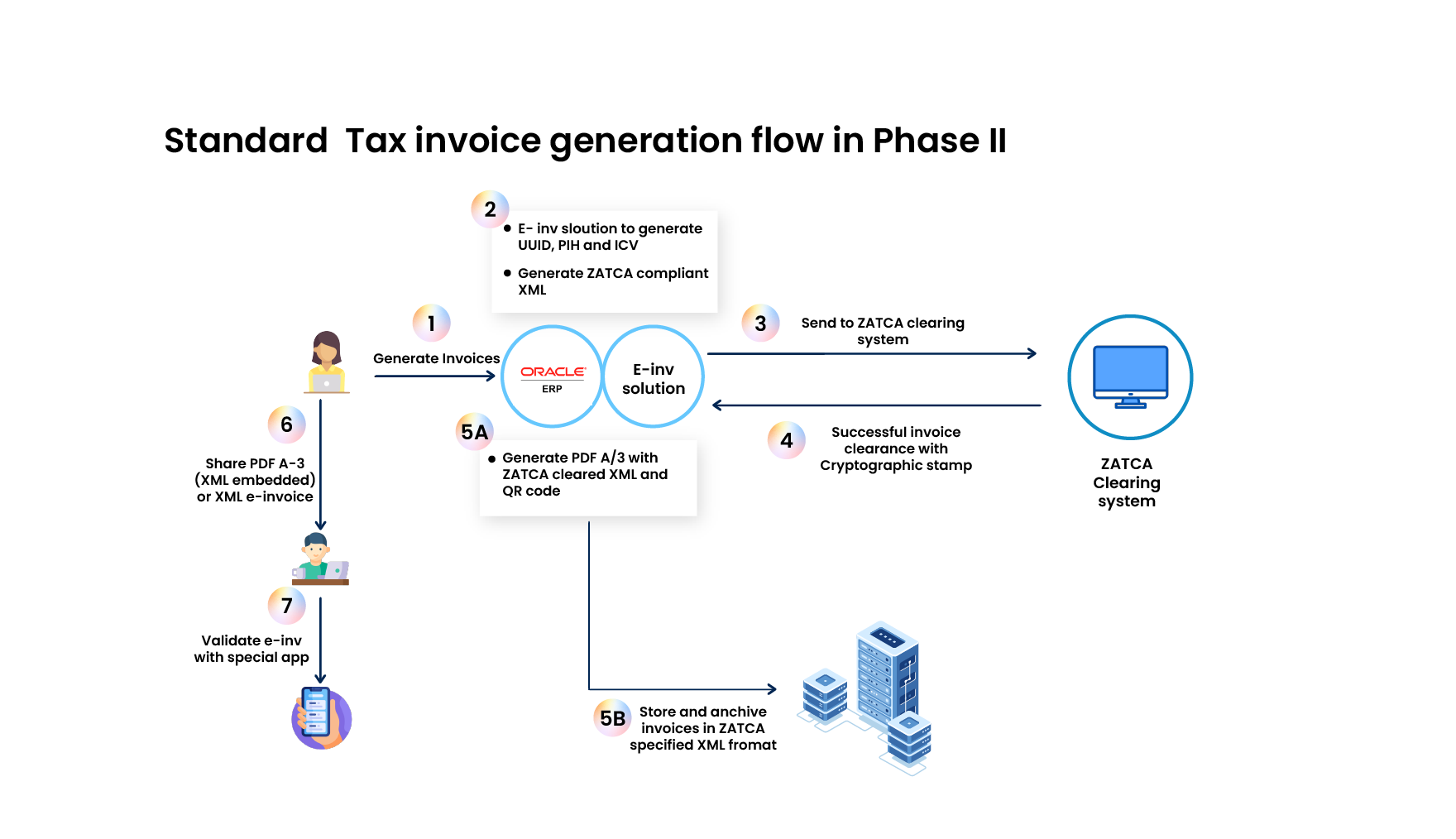
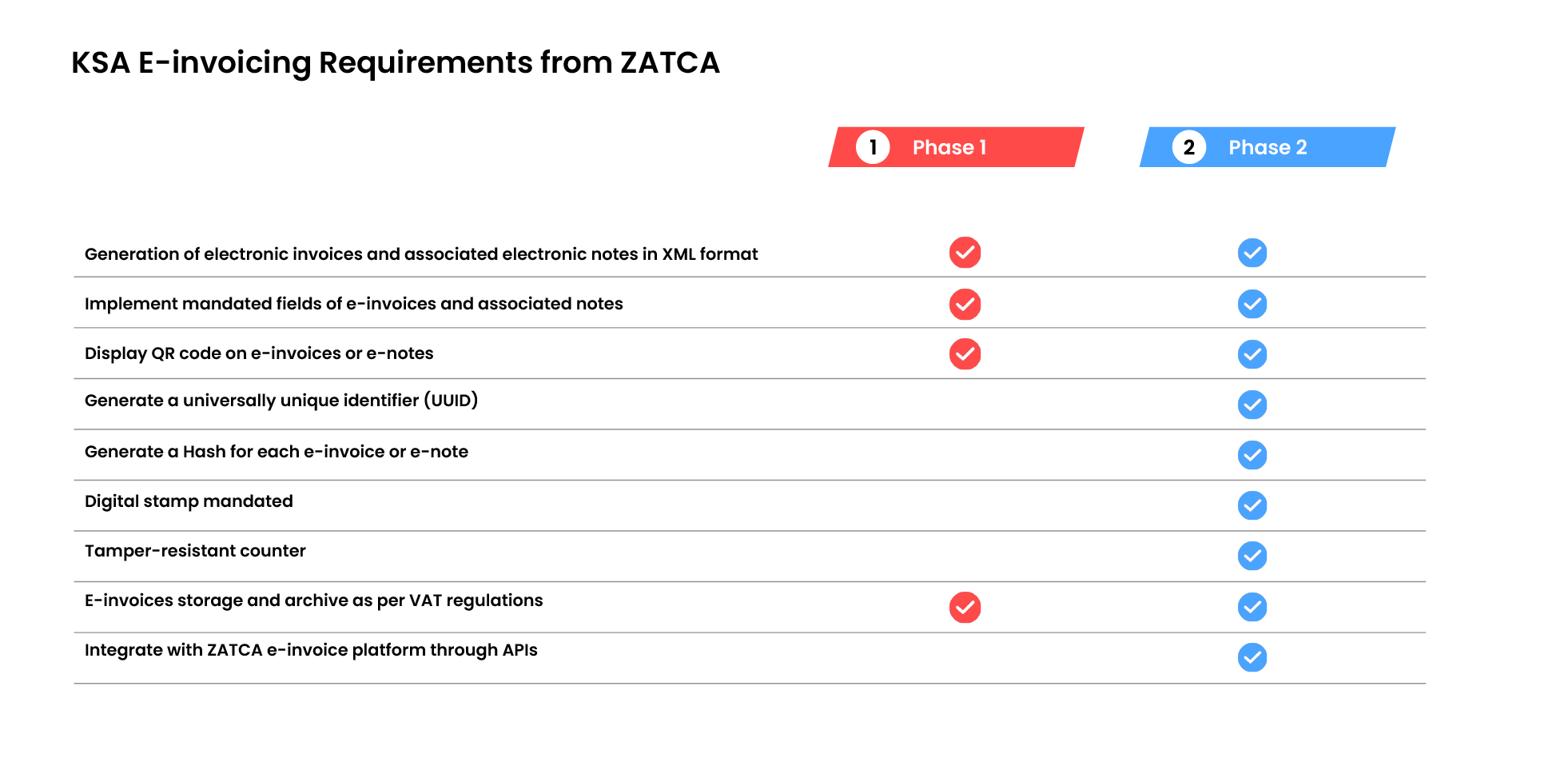
For Phase 1, all taxpayers (excluding non-resident taxpayers), and any other parties issuing tax invoices on behalf of suppliers subject to VAT, electronic invoice issuance will be very similar to invoices generated prior to 4 Dec 2021, with invoices issued through a compliant electronic solution and including additional fields depending on the type of the transaction.
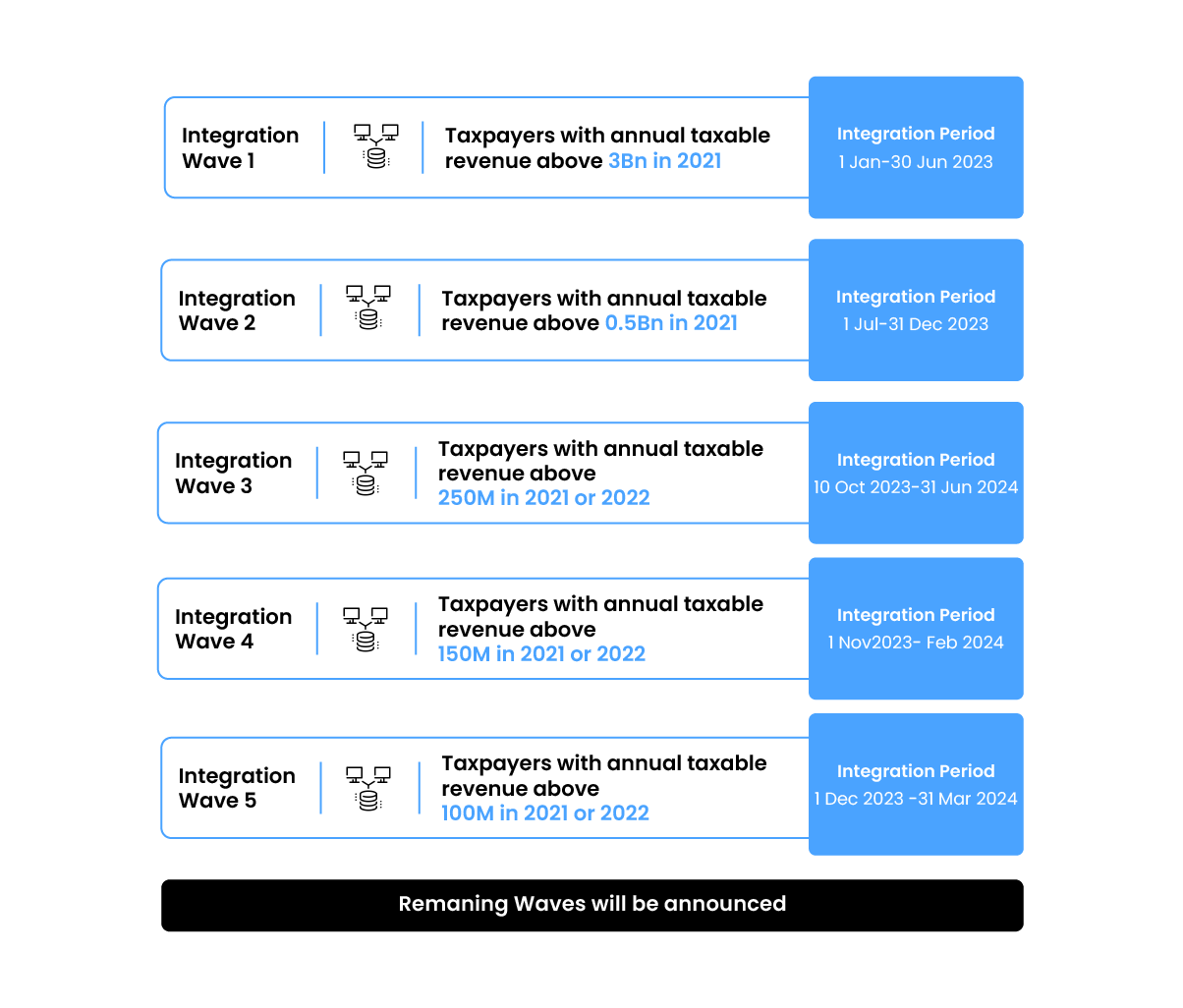
For Phase 2, enforceable starting January 1st, 2023 in waves, the electronic solution must be integrated with ZATCA’s systems and e-invoices should be generated in the required format.
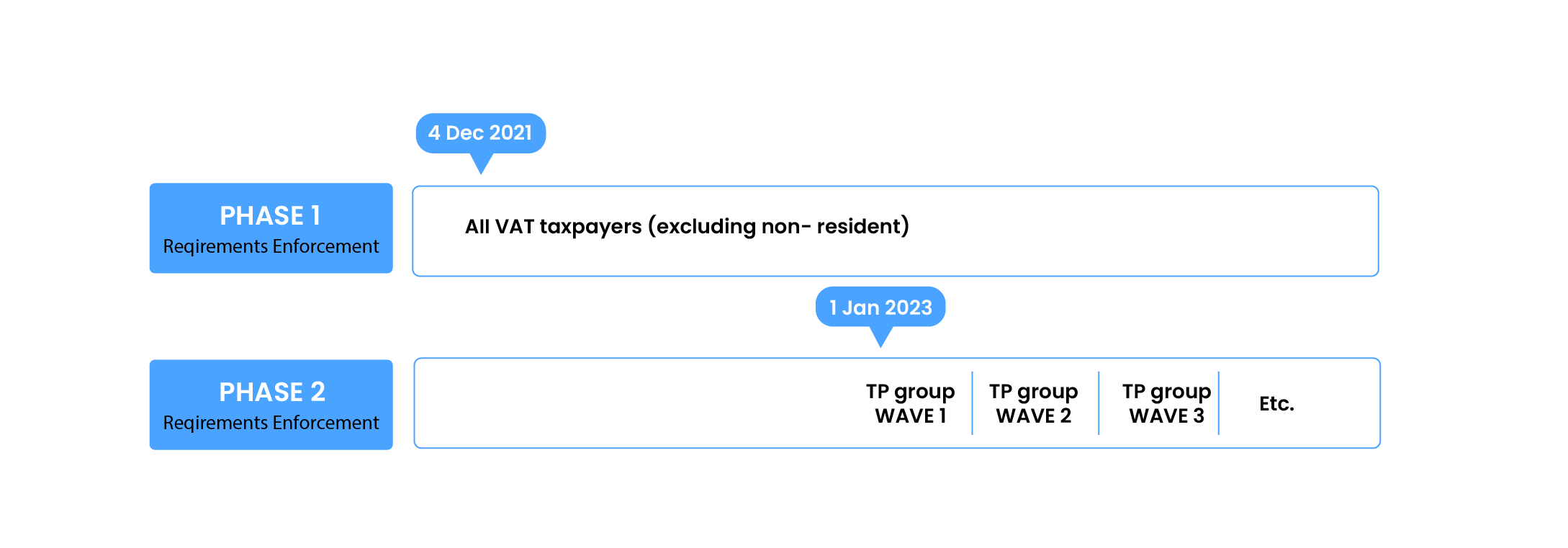
Phase 2 is further broken down into Waves based on Annual Revenue slabs.
Key Differences between Phase 1 and Phase 2:
What does ECS has to offer?
We, at ECS, have designed a comprehensive hassle-free solution, specifically for Oracle ERP, that will help you seamlessly integrate with the FATOORAH portal as per ZATCA Phase 1 and 2 regulations.
ECS offers a comprehensive custom-made solution that can cater to all your needs, be it B2B or B2C.
ECS Oracle – ZATCA Integration Solution is custom developed by our experts from Oracle CoE, and is designed to give you an end-to-end automated process covering everything from Invoice Generation to Compliance check to XML file storage to Clearance and e-delivery of PDF Invoices to end customers.
Irrespective of your Business type, be it B2B or Retail, our Solution will have you covered on both.
Key Benefits:
- Quick n Easy Generation: With robust APIs, e-Invoices can be generated in seconds or even quicker
- Analytics & Reporting: Get detailed reports indicating which invoices are cleared / have warning / errored.
- Custom Invoice Templates: We provide built-in compliance-friendly Invoice templates (including Arabic language). Existing templates can also be customized.
- No Additional Costs: We offer a comprehensive solution that does not include any hidden / additional costs for Infrastructure, Network, Operational etc